Only Luke describes the scene of the Annunciation. The angel Gabriel—the same one who had earlier announced the birth of John the Baptist—approaches Mary in Nazareth. The greeting, "Rejoice, full of grace," perplexes her. Luke records that she "pondered what this greeting could mean." This is the first of many moments when Mary ponders things in her heart. Her question, "How will this be?" differs from Zechariah's, "How shall I know this?" Zechariah demands a sign out of unbelief. Mary asks out of a desire for understanding. Therefore, he is punished with muteness, while she receives an explanation. "Fiat"—"let it be done to me"—is the response of a free person to God's proposal. Without this word, there would be no Incarnation. Our Father…
We recite the Hail Mary 10 times.
Hail Mary… Glory be to the Father… O my Jesus…
Luke describes how Mary went “in haste” to the hill country of Judah. This haste is not born of anxiety, but of joy – she wants to share the news with her relative, who is experiencing the miracle of motherhood herself. When Elizabeth hears Mary’s greeting, the baby leaps in her womb. This is the first encounter between Jesus and John – even before birth, still hidden. Elizabeth, filled with the Holy Spirit, recognizes Mary as “the Mother of my Lord.” Where does this knowledge come from? No one told her. It is a revelation given to simple hearts. The Magnificat that Mary sings is a tapestry woven from the Old Testament – echoes of Hannah’s songs, psalms of the poor of Israel. Mary does not create new words, but fills the old with new meaning.
Here the voices of the Evangelists disperse. Luke describes the journey from Nazareth to Bethlehem due to a census, the lack of room at the inn, the lack of a manger, and the lack of shepherds. Matthew says nothing about the census or the shepherds – in his account, the Magi come to a “house” where they find the Child with his Mother. These differences are not a contradiction, but rather a complement. Luke emphasizes poverty – the first witnesses are shepherds, people from the margins of society. Matthew emphasizes the fulfillment of prophecy – Bethlehem as the city of David, the star foretold by Balaam. Both agree in essence: God came into the world in the body of a child, in an inconspicuous place, recognized by those who knew how to see with their hearts.
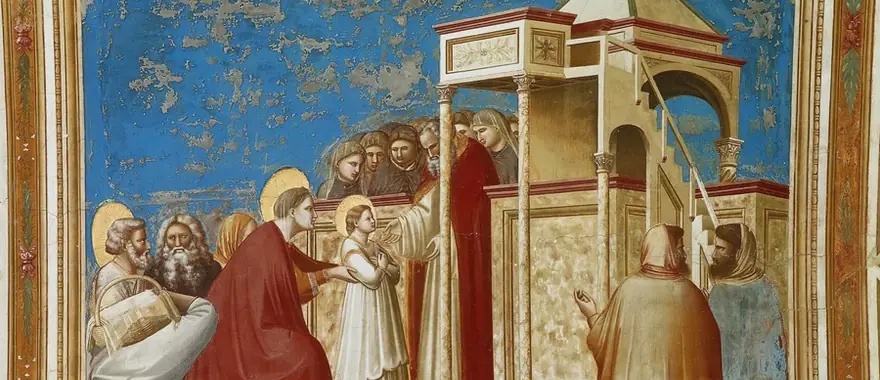
Only Luke reports this scene. Mosaic Law required that the firstborn son be “dedicated to the Lord” and offered as a purification offering. Mary and Joseph bring “a pair of turtledoves or two young pigeons” – an offering from the poor who could not afford a lamb. Two elderly men, Simeon and Anna, await them in the temple. Simeon received the promise that he would not die until he had seen the Messiah. He took the Child in his arms and uttered the words the Church repeats every evening at Compline: "Now, O Lord, let your servant depart in peace." But he also spoke to Mary about the sword that would pierce her soul. The joy of this mystery is pierced by the shadow of the Cross.
This is the last scene from Jesus' childhood—and again, only Luke recorded it. The twelve-year-old Jesus stayed in Jerusalem after the Passover feast. His parents searched for him for three days. They found him in the temple, sitting among the teachers, listening and asking questions. Everyone was amazed at his understanding. Jesus' response to his mother's reproach is the first word the Gospel puts on his lips: "Why were you looking for me? Did you not know that I must be in my Father's house?" Luke adds that Mary and Joseph "did not understand this word." And immediately afterward: "But his mother kept all these things in her heart." Faith does not require immediate understanding. Sometimes you have to carry a secret for years before it reveals its meaning.
 Top