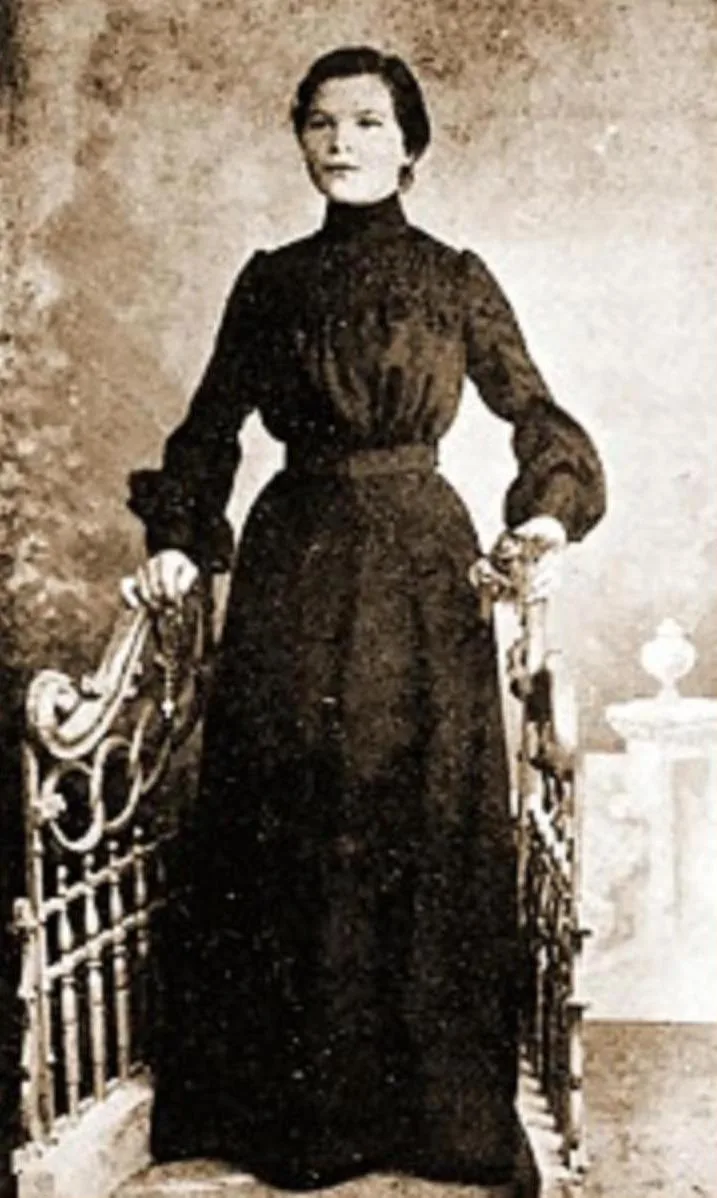
Blessed Angela Salawa.
With great joy in our hearts, we announce to the whole world that you have been declared Blessed from the secular state. We believe that you are with us. While living in the secular state, you served God, and with your life you set an example of profound faith. We ask you to bring our prayers and our supplications before God's throne. Pray that our faith may grow, that our hearts may see a brother in every person, that the OFS may grow in strength in our homeland and throughout the world. May Peace and Goodness dwell in our homes, and may the seraphic hymn of love, "My God and All," rise daily from our hearts.
During this novena, looking at your life, Blessed Angela, we want to learn from you how to imitate Christ and ask you for the graces we need, to ignite in us the charism of St. Francis, and to pray for new vocations to our communities.
Day One
THE JOY OF BEING A CHILD OF GOD
Blessed Angela experienced profound joy at the thought of the gift she received at baptism. In her Diary, she writes: "I express my gratitude for having become a child of God and a daughter of the Holy Church. I was baptized to be a child of God, He has bestowed upon me special graces and gifts of God, and has poured special graces into my soul..."—He has given me reason, will, memory, and a heart to love Him. Just as the Lord Jesus loved my soul infinitely. He created me in his image and likeness, made me his beloved child and daughter” (October 16, 1921)
We too should remember our holy baptism to live it daily.
Day Two
BLESSED ANGELA'S FAITH
Angela professed her faith not so much in words as in the daily practice of life. She deepened it by reading the Gospel and pious books. For her, God was everything. She thought of Him during daily activities, when she went shopping. She constantly pondered God's truths. She taught her friends the truths of faith and encouraged them to live more perfectly. She wanted, like St. Francis, to be an increasingly faithful disciple of Christ, imitating His poverty, humility, self-sacrifice, and self-sacrifice for others. She admonished her friend: “Do not listen to people or imitate what people say, but listen to God, commend yourself to Him, and follow the Church's guidelines” [some statements no. 8]
Faith is a person's response to God's revelation. This response is always expressed in concrete actions, words, and thoughts. Following the example of our Patroness – Blessed Angela – may our lives also be a convincing testimony to the fact that in the modern world it is possible to act in accordance with one's faith.
Day Three
VOCATION
Aniel found the true gift of her vocation. For a time, she harbored a hidden hope for the religious life. She considered the Carmelite Order, where she desired to fulfill her desire for holiness and even applied, but was rejected due to lack of a dowry. Her confessor also forbade her from joining the Order. She obeyed him. Through a life event, she learned that the Lord was calling her to the lay faithful. She understood that in the Church, the religious and lay states complement each other. Thus, she pursued Christian perfection in her daily life – as a servant. She accepted this state in a spirit of faith and sacrificial love for her Lord Jesus. In her Diary, she writes: "How glad I am and how I thank God that I am not in a convent – in a convent, I could not mortify myself as much as in the world." Deeply imbued with the spirit of faith, she constantly strived to shape her entire secular life in this spirit. After a long experience of spiritual life, she could say: "Considering my life, it seems to me that I am here where God has called me since childhood" (May 30, 1921).
The prayerful soul of this simple woman, in love with God, teaches us that holiness is possible in every state of life. For God has given every person a vocation, whether to the priesthood, religious life, marriage, or singleness.
Day Four
HOLY MASS
Aniela experienced every Mass deeply. She always attended Mass diligently and devoutly, rushing to Church daily and receiving Holy Communion. Even her numerous service duties never hindered her. She often shortened her nightly rest to begin the day with an encounter with the Eucharistic Christ. Whenever she could muster some strength, she would walk with great difficulty, clinging to the wall, to St. Nicholas Church to attend Mass and receive Holy Communion. This was the most joyful moment of her day. After receiving Holy Communion, she remained in deep concentration and offered several hours of thanksgiving.
The Eucharist is the center of the Church; may it also become the center of our lives for us. We should participate in it as often as possible.
Day Five
EUCHARISTIC PIETY
Aniela had a great devotion to the Eucharist and the Blessed Sacrament. She especially loved Adoration and frequently visited the Blessed Sacrament at the Church of St. Joseph, owned by the Bernardine Sisters and the Franciscan Fathers. Every day, she knelt motionless on the floor for a full hour, and sometimes longer, with her eyes fixed on the Lord Jesus exposed in the monstrance. She said: "Before our Lord Jesus Christ exposed in the Blessed Sacrament, it is best to speak as little as possible – to remain silent." She knelt for a long time in great concentration, convinced that the Lord Jesus was so abandoned. In her Diary, she noted: "The Lord Jesus from the monstrance complained very much about people's ingratitude… He said that he was very much forgotten even by his closest relatives and that he received almost no honor from the multitude of people" (July 7, 1917).
Adoration of the Blessed Sacrament is a difficult prayer. We often want to fill our time of encounter with the Living God with a multitude of words. It also happens that the focus of such prayer is ourselves, not God. To be with God in silence, to gaze lovingly at Love, to allow Him to speak – this is the meaning of Adoration.
Day Six
THE CROSS IN THE LIFE OF BLESSED.
A living bond with Jesus in the mystery of the Cross allowed Blessed Angela to endure many humiliations and injustices with equanimity. She humbly accepted being publicly dismissed from the confessional. She endured accusations of theft and dismissal from ministry. She calmly accepted the humiliation she experienced when a certain person struck her in the face. Angela silently accepted the slap, and when asked why she didn't respond, she replied, "The Lord Jesus also received a slap, so for His sake I endured mine in silence." She did not rebel, nor did she take offense. She offered whatever suffering she experienced in her life for the conversion of hardened sinners. She accepted such humiliations, offering them to Christ. With great trust in God, she endured the hardships of a serious illness. She offered her suffering to the Lord Jesus in the spirit of reparation for the sins of the world.
Whoever does not take up his cross and follow me is not worthy of me (Mt 10:38). If I wish to be a disciple of Christ, I must carry my cross. Let us faithfully follow the Crucified Lord, and in Him let us learn to discover the value and meaning of the difficulties and crosses of daily life.
Day Seven
HUMILITY
The modern world does not want to hear about humility. This virtue is consciously or subconsciously eliminated from daily life. Yet it is a virtue clearly recommended by Christ Himself, who commanded His disciples to embark on this path: "Learn from Me, for I am meek and humble in heart" (Mt 11:29). Service demanded great humility and discipline from Blessed Angela. Gradually, she accepted service voluntarily and with full awareness, as the most humble state in which she would most fully respond to God's grace. She writes: "And that is why I voluntarily chose the state of a servant and to be a servant, scorning all the happiness that presented itself to me, and confident that in this humiliating state I would respond to God's request" (May 30, 1921).
Aniel found in Christ an example of true service and the strength to do so. She wanted to be forgotten, hidden. And even more, she saw in this the path marked out for her by God. And she only wanted to fulfill God's will.
Humility is accepting the truth about oneself and being grateful to God for every moment of life, finding joy in small things. Humility is a trusting look toward heaven, where a loving God has prepared a place for us. One who is humble and small, always at the feet of others, has a great heart for God and neighbor. Be always small, and God will exalt you.
Day Eight
WORK
had an exceptional respect for work. She acquired it from her family home, learning from her parents how to conscientiously perform one's duties. She was diligent in both large and small matters. And she did everything for Jesus. She wanted to serve and please God above all else, not people. Aniela fulfilled the duties of her state, but her heart constantly yearned for God, who was the highest value in her life. In the zealous fulfillment of her work, she saw the most important task and, at the same time, the simplest path to self-sanctification. She was convinced that God cared less about the greatness of the deed, but rather about the quality of its execution. As a servant, she did not think of extraordinary deeds, but performed her household duties perfectly. In her Diary, she wrote: "In the most difficult moments of life, always remember that whatever I do, I do it all out of love and holiness for Him whom my soul loves" (July 1921).
Work not only provides a living but also provides an opportunity to develop conscientiousness and faithfulness in small things. Those who work honestly appreciate and respect the work of others. How do I treat my work? Do I not place it above Gospel values, or does overwork and the pursuit of possessions rob me of my zest for life and hinder my prayer? Work can never become a goal in life, but a means on the path to Christian perfection.
Day Nine
SENSITIVITY TO THE NEEDS OF OTHERS
Aniela, captivated by the example of St. Francis of Assisi, learned from him sensitivity to human misery and need. She had a great heart for all those in need of support, both spiritual and material. She wanted to do good to all. She wrote to a friend these words: "I very much desire that you may be well." She shared her lunch with the poor. She could not remain indifferent to the requests of those in need. Aniela developed a wide-ranging Aid campaign during World War I. She spent many hours among the wounded. She visited hospitals and worked for a time as a nurse. She was also sensitive to people's moral destitution and cared for their spiritual well-being. She reminded wounded soldiers of the need for confession and Holy Communion. She also spoke of the need for suffering and preparing to encounter God in the mystery of death. She always encouraged everyone to live a good life, be pious, and serve God faithfully. She also cared for prisoners of war, bringing them food with her friends. Through her life, she demonstrated how much can be done for others, even in the most humble circumstances. And she drew the strength to love everyone and to be good from Holy Communion.
Aniel teaches us to rush to help all those in need and to be open-minded to the needs of others. In those in need, we can see Christ. By rushing to serve the poorest, we become like Jesus – the Good Samaritan. We become instruments of peace and love in the hands of God.
 Top