How to Pray the Novena
The novena can be prayed for any need on nine consecutive days, preferably nine days preceding the commemoration of St. Hedwig: May 30th - June 7th before the commemoration of her canonization (June 8th) or July 8th - July 16th before the commemoration of her death (July 17th). To pray the novena properly, it is advisable to follow the instructions below:
We pray the novena in honor of Christ through the intercession of St. Hedwig, through whom He shows us the most important Christian virtues and teaches us to cultivate them. Let us therefore ask the Lord for the grace of a closer bond with Him, following the example of the saint, and that, just as her entrustment to Christ resulted in good for others, our lives, through greater devotion to God, may also contribute to obtaining some special benefit, for which we pray in this novena.
To truly unite ourselves with Christ and, like St. Hedwig, Jadwiga, with Him, fulfills her mission as we go through life. Let us strive to attend Holy Mass every day, and at least receive Holy Communion on the last day of the novena.
Each day, we begin the service with an Introductory Prayer for each day.
We read a meditation for each day, encouraging our hearts to imitate the saint.
We pray an appropriate petition attached to each meditation and make a daily resolution.
The prayer concludes with the Litany to St. Jadwiga.
If the novena is being prayed in community, one of the following hymns about St. Jadwiga the Queen may be sung at the end.
INTRODUCTORY PRAYER FOR EACH DAY OF THE NOVENA
Lord Jesus Christ, through Saint Jadwiga, you teach us to see with the eyes of faith and to act in accordance with what you reveal to us. Through her intercession, grant us the grace of your closeness and docile acceptance of your will. Amen.
DAY ONE
Reflection: The Holy Queen Submitted to God in Everything
When we learn about the life of St. Jadwiga, the beautiful and youthful ruler, we are struck by the mystery of her holiness. We admire her for all she did for the Polish Crown, for Lithuania, and for other European nations. We thank God for her wisdom and foresight—talents so significant in a politician. But what is most astonishing about these spectacular moves of the monarch is that she took no credit for herself, but made everything dependent on God. She felt completely submissive to Christ, the only King whose love she experienced and did not want to disappoint.
Her life, although, as befits a royal child, had already been meticulously planned by her parents, yet it unfolded quite differently. Jadwiga interpreted it as the will of God, from whom she refused to deny anything. In this spirit, she obediently left the country of her birth and, as an eight-year-old girl, came to Poland, only to assume responsibility for her new homeland at the age of ten. For Christ's sake, she also abandoned her previous marriage plans, as the evangelization of Lithuania was more important than her personal life. Therefore, she offered her hand in marriage to a Lithuanian prince, unknown to her, raised in a culture alien to her, and much older. Only then did Jagiełło accept baptism and open the door to the Catholic faith in the East.
Historical sources speak of Jadwiga's boundless devotion to God and His will: "She rejected even things permitted and appropriate for the royal estate, for fear that they offended God" [J. Długosz, Annals…]. She did so out of love for Christ and, with His help, made difficult decisions: "We spent many sleepless nights pondering how to bring the intention of our hearts to fruition; finally, placing our purpose in the Lord, we decided" [Foundation Act…].
She considered everything with God and entrusted herself to Him in her daily tribulations, zealously caring for her subjects, whom she considered above all not her property, but God's children, whom she served as Christ Himself. To Him she owed her small, perhaps unknown, but also great victories. Let us note how this holy Queen, who had extraordinary opportunities in the world, never forgot to whom gratitude and the highest honor are due. Neither suffering nor earthly splendors have obscured her unique and certain Love – Christ the Lord. Let us learn from her obedience to God, especially in matters that may require sacrifices and decisions beyond our strength. God always builds a greater good on our humble submission. The happiness of many often depends on the right decision made in faith.
Prayer
Saint Jadwiga, teach us always to choose God's will!
Lord Jesus Christ, through the example of Saint Jadwiga, You have made us know what it means to seek the Kingdom of God above the affairs of this world, spiritual values above transient things, praise from You and not from people. Help us to agree with a sincere heart to daily tasks for Your sake.
Resolution
I will try today to willingly fulfill what will be inconvenient yet necessary for me. Do this more and more often.
Litany to St. Jadwiga the Queen
DAY TWO
Reflection: Saint Jadwiga gazing at the Crucified
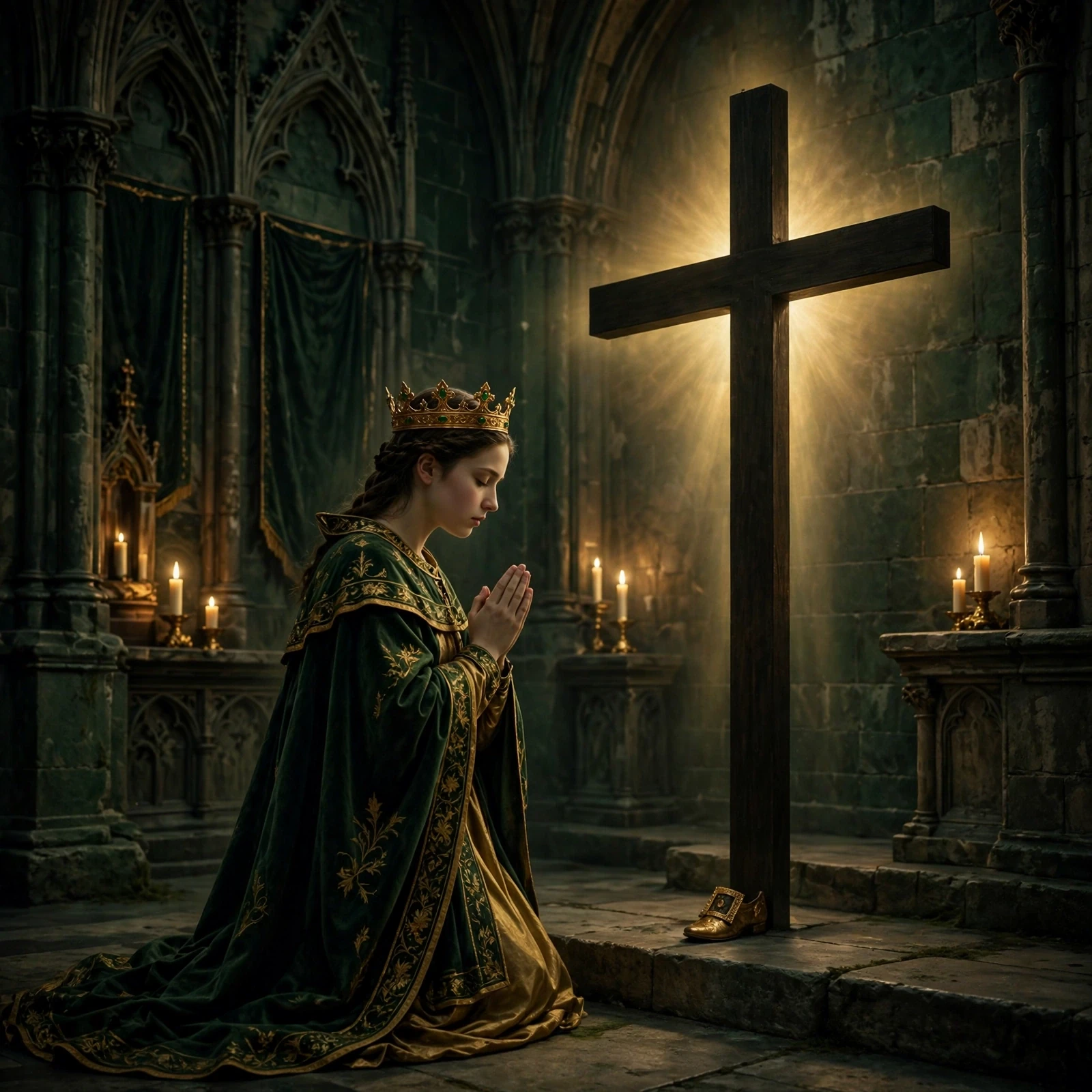
Among the most typical images of St. Jadwiga are those depicting the queen at the foot of the cross. This is not surprising, as medieval saints were often depicted at the foot of the cross as a sign of their compassion for Christ and their entry into His path of sacrifice.
Jadwiga, whom we wish to follow in this novena, eagerly contemplated the mystery of Jesus' suffering while kneeling at the cross. She did this so often that she is remembered for her gaze on the Crucified. It is written of her that she spent hours in prayer in Wawel Cathedral before the image of the suffering Christ. Beneath this cross, she learned obedience to God and love for humanity. In this place, she conducted her conversations with Christ and made important decisions, not only personal but above all political. This may have been the secret of her extraordinary reign. Her personal "intimacy" with the crucified Christ did not consist only in compassion for His suffering, but above all in drawing strength from His love for the Church. Tradition says that the Crucified One said to her, "What do you see?" (fac quod vides), meaning that he advised her to act as she could see with the eyes of faith, gazing upon Him, who offered Himself in sacrifice for people out of love for them. For her, the cross was a school of service to humanity and the most humane politics, which consisted in revealing the purest truth and the most certain love, that is, God. And this was accomplished not through teaching, but in daily service to people and in caring for their true good, which is the knowledge of God and faith, not just material goods, which, by the way, she remembered in her royal responsibility. The Crucified One made her believe that man is created for higher things than mere earthly joys, as a result of which "in her conviction, the earthly kingdom was an exile" [St. [From Skarbimierz, Sermon…]. Enduring goods are achieved in great freedom, even leading to the sacrifice of one's life, because the disciple of Christ fears not those who kill the body, but rather the one who can threaten the soul, namely, Satan (cf. Luke 12:4). Therefore, Jadwiga does not shrink from any renunciation or suffering that could and always did bring benefits to others. Following St. Paul, we would say that she filled in what was lacking in Christ's sufferings for the good of His body (Col 1:24).
Imitation of the Crucified One is usually associated with asceticism. The saint was a classic daughter of the era in which she lived. Długosz's chronicles cite the information that: "During Lent and Advent, you mortified your body with a hairshirt and with extraordinary abstinence." Certainly, courtly conditions and royal dignity did not permit extreme asceticism, which, also because of God, from whom power comes, was entitled to appropriate honor and splendor. Therefore, she undertook these practices discreetly, without distinction, especially during those times when the entire Church was trying to emulate the suffering Bridegroom. This was also an expression of her humility and wisdom, as well as a proper discernment of her role and calling. Evidently, the counsel of Christ, who warned against vain ostentation in penitential practices and acts of mercy performed solely for one's own sake, for one's own glory, and to satisfy one's ambitions, had sunk deeply into her heart. In this experience of the cross, she desired to be as hidden from the compassion and praise of this world as Christ, stripped of his glory, to whom God the Father had finally permitted the experience of complete loneliness. And "to test her patience even more thoroughly, heaven sent upon her severe illnesses and various sufferings, and she was tested like gold in a crucible" [Stanisław of Skarbimierz, Sermon]. Crucified love is, above all, a love that is patient (cf. 1 Cor 13:4), one that knows how to wait, trusting in God's wisdom and mercy. How far we fall short of such love! After all, we often fear suffering, resent its coming because it is unjust, or—worst of all—we blame God himself for his supposed indifference toward suffering people, especially those who are clearly innocent, such as children, the elderly, or those born disabled. Only occasionally, and sometimes even after long experiences, do we come across the image of Christ suffering for us and on our behalf, completely innocent, a holiness truly untainted by sin. Only in Him, so pure and humbled by suffering and death, do we see the ideal of true love—free, selfless, and generous. In this weakness, the power that later becomes the power of the saints is revealed. Jadwiga drew from it, as Stanisław of Skarbimierz recounts: "He from the height of his throne supported her in patience, for she endured much in secret" [Stanisław of Skarbimierz, Sermon…].
Prayer
Saint Jadwiga, obtain for me from Jesus crucified a patient and understanding love!
Lord Jesus Christ, crucified for our sins, You teach us through Saint Jadwiga of Wawel how He did not obscure the splendor of Your Passion. I implore You, through the intercession of this saint, open my heart and eyes to the saving meaning of suffering and protect me from the temptation to protect myself from difficulties and from the fear of suffering.
Resolution
Today, especially, I will not overlook the possibility of sacrifice in secret. I will strive to ensure that self-love does not diminish the value of this sacrifice. I will ensure that my intention for self-denial is pure each day.
Litany to Saint Jadwiga Jadwiga the Queen
DAY THREE
Reflection: Saint Jadwiga adoring Christ present in the Eucharist
The difficult, sacrifice-filled life of Saint Jadwiga would not have been holy if it had not been united with Christ and His only effective and God-pleasing Sacrifice. The Queen was often seen at the foot of the black Crucifix in the cathedral and before the Blessed Sacrament. In Christ's presence, her decisions matured, bearing impressive and lasting fruit. We share in them to this day. What is the secret of Jadwiga's meditation and adoration? We don't know this from her, but from the blessed results of her prayer, we can be convinced that she was aware of God's love and closeness. She recognized it in the cross and experienced it fully in the Eucharist. She understood that Christ suffered and died not only to free man from sin, but to unite himself with him, so that nothing could destroy the friendship to which God had called man. Knowing God the Redeemer led her to His Person in the Blessed Sacrament. She was known for her attachment to this unique presence of Christ in the Eucharist, which nothing can replace.
Her zeal in praising God, close to her here on earth in the Blessed Sacrament, is evidenced by her concern for the uninterrupted worship of the Eucharistic Christ. Unable to do so herself due to her duties, she understood those who, absorbed in various activities, could not tear themselves away from them. At the same time, she felt a duty of thanksgiving to God, whose love and goodness she constantly experienced. She desired that others also have this opportunity. Therefore, she sought to provide a kind of substitute. She established a community of spiritual men, priests, who, singing psalms, persevered in prayer before God on behalf of herself and others. Thus was established a college of sixteen psalterists, whom she relieved of all pastoral duties and provided with subsistence and accommodation in a house on Wawel Hill. In this way, she made the cathedral a center of constant worship of Christ, not only through the liturgy, but also through adoration of Him when it was not celebrated.
This was a great sign of her personal faith and veneration of Christ present in the Eucharist. By making the capital's cathedral such a unique and living center of the Eucharist, she demonstrated that daily life must be based on this real Divine presence, and thus indicated the true source of life for humanity and the nation.
Isn't this an example and an encouragement for us, the people of today, to appreciate more this extraordinary gift of God's presence? Let us strive not to focus our time on God, for He is its Lord and giver. Who could have more responsibilities than a king? And although he had many collaborators, no one could relieve him of his worries and responsibilities. Jadwiga was a king, yet she always remembered who her Lord truly was and devoted the most attention to Him. Therefore, we have no excuse for not doing so when we look to her example. All that remains is to reflect on our daily relationship with God, who lives so closely with us and gives Himself to us so that we may triumph in Him each day. Let us strive to willingly remember Him, our daily prayer, the need for adoration and being alone with Him in silence, and the joyful reception of Him in the Eucharist.
Prayer
Saint Jadwiga, teach us to love Christ!
Lord Jesus Christ, through Saint Jadwiga, You show us our true desire for You and the concern to develop our love for You. Through her intercession, I ask You for the grace of a deeper understanding that nothing is dearer than You. Grant me the desire to seek You where You are, and above all in the Holy Eucharist. Resolution
Today, after meditating on this word, I will try to find 15 minutes for adoration of the Lord Jesus in the Blessed Sacrament. If this is impossible, I will devote fifteen minutes to meditating on the parable of the lost sheep (Luke 15:1-7), which shows Christ's love for every person. Often, and preferably daily, find time exclusively for God to thank Him for His love and to become more sensitive to it.
Litany to St. Jadwiga the Queen
DAY FOUR
Reflection: St. Jadwiga Seeing with the Eyes of Faith
Faith allows us to know God, humanity, and the created world in ways other than the natural and rational. Through the grace of faith, we can reach God's plan and the meaning of our existence. Faith allows us to see things through to the end and to subdue the earth with greater freedom (cf. Gen 1:28), to which the Creator has authorized us. Let us not, however, think that faith is merely knowledge and thought. The sign of true faith is a proper attitude toward God and others. And this is love. A disciple of Christ "sees" differently and "acts" differently than a non-believer. A person's faith can be recognized by its fruits, which are deeds of love.
St. Hedwig introduces us to the world of faith through her life. Looking at the lives of the saints, we begin to understand that everything can be viewed differently when we consider Christ. She was aware of His presence and, through Him, understood her calling. She accepted difficult things because they were just for God's cause. Her faith was evident in her fervent piety, in her care for others, and above all, in her perception of their spiritual needs and in conducting politics with love and sensitivity. Looking at people in the spirit of faith led her to a deep awareness of communion with Christ in His special servants: priests, bishops, and the Pope. Her extraordinary devotion to the Vicar of Christ was an expression of her faith in the special presence of God in the Church. Jadwiga acquired this profound faith from her family home, where she learned reverence expressed through prayer, participation in the liturgy, and support for the Church through foundations and sanctuaries. She continued this as King of Poland. The entire responsibility for decisions fell on her girlish shoulders. Perhaps nothing more than closeness to Christ and faith in Him helped her remain courageous and faithful. Without faith in God, she could either fall into dependence on influential and older advisors or experience frustration due to the incompetence of an unprepared and too young nature. Neither of these things happened to Jadwiga, because at the center of her life was Christ, who opened her to the very circumstances that He Himself discreetly sent for her support.
Let us now look at the end of her life, when she gave birth to her firstborn daughter, Elizabeth Bonifacia, and lost her a few days later. What faith she had as a mother that she completely accepted this, and even earlier, as if by prophetic intuition, she had made her loved ones aware of her modest and open expectation of a delivery. She experienced this joyful time for every mother with great concentration because of God, in whom she entrusted herself completely, regardless of what He would allow for her. It was written of her that: "She pushed worldly luxury away from herself and did not wish to avail herself of it now, in the danger of death, which childbirth often brought, because the Lord of Heaven, who, having stripped her of the shame of barrenness […], did not wish to please her with the brilliance of precious stones and gold, but with modesty and gentleness" (J. Długosz, Annals…).
In turn, we know today that her unfulfilled physical motherhood found its even more perfect continuation in her spiritual motherhood to the nations of Europe. Let us learn from her to gently accept life's difficulties and to perceive God's deeper plan within them. Let us also strive to discover the help God sends us in these circumstances, giving us a chance for victory, and with the conviction of faith, engage in building the Kingdom of God, which, although invisible, is among us. Let us live as if we saw the Invisible One with our eyes (cf. Heb 11:27).
Prayer
Saint Hedwig, lead us on the path of trusting faith, which does not ask, "Why?"!
Lord Jesus, through Saint Hedwig, you bring yourself closer to us as the Good Shepherd who watches over the smallest detail of our lives. Be merciful to our doubts and unnecessary questions, and in your kindness, give us a spirit of childlikeness and unconditional trust in Your incomprehensible wisdom. Resolution
I will try to live today without complaint or grumbling, and in difficult moments, with faith, invoke Your name, blessing It for the wisdom incomprehensible to me, which leads through tribulations to the joy of victory and lasting merits for others and for myself.
Litany to St. Jadwiga, Queen
DAY FIVE
Reflection: Saint Jadwiga, the Beautiful and Merciful Lady
Chroniclers and eulogists of Jadwiga's holiness wrote of her: "Her face was very beautiful, but even more beautiful were her manners and virtues" (J. Długosz). "She lavished kindness and mercy on those in need [...] We saw and learned about her extraordinary beauty, her engaging manner of speaking, her noble lineage, and even more noble manners" (Stanisław of Skarbimierz). The most famous legends about Saint Jadwiga tell of her tender heart, sensitive to human misfortune and poverty. The Holy Queen often distributed alms, and when she strolled the streets of Krakow with her ladies-in-waiting, she bent over beggars begging for help, and would give money to hungry yaks. Most touchingly, even in those who, out of modesty, didn't ask, she noticed the embarrassment and sadness, to which she responded with mercy. For example, she gave a precious pin to a bricklayer who worked on the construction of the Carmelite church in Piasek, formerly Garbary, for the treatment of his sick wife. On another occasion, she ordered peasants from Greater Poland, whose lands and possessions had been unjustly taken away, to immediately compensate for their losses, but asked, "Who will return their tears?", wanting to draw attention not only to the material aspect, which can always be compensated somehow, but also to the painful experiences and dignity of the human person, which are much more difficult to compensate. Only God can do this, for "He records our wandering life and stores our tears in His bottle" (cf. Ps 56:9). Such events surely abounded, as numerous legends have been composed about them.
Jadwiga's mercy also became evident through her numerous foundations of hospitals for the poor, traces of which remain to this day in Biecz, Krakow, and Sandomierz. She endowed these hospitals herself, and what's more, she attended to the sick there, for she saw in them the face of the suffering Christ, whom she sought to bring relief, and she nurtured Him Himself in them. Her faith and love for Christ opened her heart to the needs of the people whom she came to help like a mother. One can admire her sensitivity, generosity, and a feminine, almost Marian, sense of intercession, and care. It was written about her: "For we saw that she was the mother of the clergy, the benefactor of widows, the comforter of orphans, the shield of the poor, the refuge of the wronged, the advocate of those excluded from the presence of our king. Yet to those who were once filled with fear by the king's presence and terrified by his justice, she brought joyful relief through her personal intercession" (Stanisław of Skarbimierz).
St. Jadwiga was a faithful disciple and servant of Mary, whom she venerated in the mystery of the Visitation, the mystery of the Mother visiting people and bearing them the Son, the living God. Sometimes so little is needed to bring relief to another. We don't even have to have as much material resources as Jadwiga, because the greatest gift we can give is love, expressed through a kind word, a smile, time, or good advice. Let us learn from Jadwiga, the beautiful and merciful Lady, to imitate Mary, Queen and Mother of Mercy. Let us learn to look at others with her merciful eyes and to offer help with humility, without arrogance, that does not humiliate others but rather reminds them of their royal dignity.
Prayer
Saint Jadwiga, open my eyes and heart to the needs of others!
Lord Jesus Christ, you taught St. Jadwiga to perceive human misery and to bring relief to suffering with love and wisdom. Teach me to think of others more than myself and to willingly share with them what they receive from You for their spiritual growth and, if such is Your will, for the improvement of their temporal situation as well.
Resolution
I will try to do something for my neighbor today, even the smallest thing, with the intention of Marian love and with the awareness of discovering the face of Christ in that person. It can be a simple daily conversation or contact with loved ones, or, if the opportunity arises, a good deed. Or, undertake it more often.
Litany to St. Jadwiga the Queen
DAY SIX
Reflection: St. Jadwiga the Queen, living in the image of the Gospel figures of Mary and Martha
Whoever truly imitates Christ will recognize in Him the ideal balance between prayer and action. Jesus lived among people, taught them and did good to them, and at the same time was constantly united with the Father. He even withdrew to a mountain or secluded place to speak alone with the Father. The three years of His public ministry were preceded by thirty years of hidden life, dominated by prayer and quiet work together with St. Joseph in the intimacy of the Nazareth home. And then another stage of preparation for external activity – a radical time in the desert for forty days, in spiritual confrontation with the ruler of darkness. The Master himself teaches us this before we encounter His encounter with Mary and Martha (cf. Lk 10:38-42). Mary in contemplative listening, as if in prayer, and Martha warmly bustling around her beloved Guest. Christ gave the first of these attitudes decisive importance, as the "best part" that ensures the quality of all other actions. Without love for Christ and submission to His will, no action is meaningful. It is like "great steps beyond the path," beyond the Way that is He—Jesus Christ.
As for Jadwiga, we know that the Gospel model of Mary and Martha's life was particularly close to hers. In this spirit, she imitated Christ, devoting herself completely to Him in prayer and in daily unity with His Sacrifice, like Mary, and in serving humanity in all aspects of life, like Martha. Looking at the Queen's life and wanting to maintain her in this sober balance, the contemporary theologian Henryk of Brzeg, known as Bitterfeld, dedicated his work on active and contemplative life to her, in which he asserts "that active life without contemplation does not proceed properly." Prayer and a growing intimacy with Christ provide inspiration, strength, and at the same time, a longed-for respite experienced in communion with the Lord for an active life.
St. Hedwig, who participated in so many areas of life and took the concerns of her subjects so closely to heart, experienced the burden of life, which was sweetened by God, who was close to her in the Person of Christ. Bitterfeld wrote to her in his treatise: "After numerous hardships and worries, the cup of your bitterness, which you must taste in your active life, immersed in contemplation, you will finally mingle with the sweet presence of God, which, after all, tends to bring greater joy the more fervently one desires this presence with a pure mind." This spiritual balance is manifest in Jadwiga's decisions, which she made and implemented after a prior prayerful dialogue with the Crucified. She tried to do what He allowed her to understand in prayer, what He "saw" with the eyes of faith. Tradition has it that she heard "what you see" from Christ on the Black Crucifix in Wawel Cathedral. The same author encouraged the Queen to be courageous and faithful like Moses, who spoke with God as a friend, and at the same time, be an effective guide for the life of the chosen people during the turning point when Egyptian slavery gave way to the promised land. Like Noah, after whom she should have been, free from worries, she sometimes rested like a dove with him in the ark, not fearing that "the desire to rest permanently in the ark would make it useless for the flock, while at the same time the constant striving to remain outside the ark would prevent her from wanting to separate herself from the true Noah, Jesus Christ." Thus, in Jadwiga, we see a model of Christian balance and true mysticism, which presupposes a real rooting in the life of God through faith, prayer, and the sacraments, and the resulting desire to share these gifts through acts of love for others. Hence, Jadwiga devoted so much attention to evangelization and care for the Church, as well as to various works of mercy. Listening to the Lord's words allows her to peacefully enter into and accept what, by His will, has become hers in the sense of caring for nations and the safe lives of people.
Prayer
Saint Lady of Wawel, obtain for me from God the grace of faithfulness to daily prayer and to come to know Christ through His Word!
Lord God Almighty, in Saint Jadwiga you give us an example of the harmonious integration of prayer and action. Grant me the patience to discover Your will regarding all my plans and to cultivate prayer in all circumstances of life.
Resolution
I will try to do something for my neighbor today, even the smallest thing, with the intention of Marian love and with the awareness of discovering the face of Christ in that person. This can be an ordinary daily conversation or contact with loved ones, or, if the opportunity arises, a good deed. Or undertake it more often.
Litany to St. Jadwiga the Queen
DAY SEVENTH
Reflection: Saint Jadwiga Caring for Faith
Who knows if Jadwiga's greatest concern as king wasn't caring for human faith and dignity, since these most outstanding achievements of her reign are closely linked to God and the spiritual dimension of human life. Raised in the deeply religious family of Louis the Hungarian, who also founded Marian shrines, she was from the beginning sensitive to matters of faith and the fate of humanity. The most significant fruit of her life was the evangelization and baptism of Lithuania. She never went there herself, but her discreet concern for the young Church in those lands was expressed through the foundation and endowment of churches, sending missionaries, and educating clergy, including in Prague, where she purchased a special house for them to stay during their studies.
Jadwiga was a very far-sighted and prudent ruler. She knew that the proclamation of the Gospel and pastoral work require not only faith and a zealous heart, but also preparation, that is, solid knowledge, which is irreplaceable in confrontation with the sophistication of reason, with pagan practices, magical thinking, and the naivety of simple people. She was anxious that pastors should be educated and prepared for this task.
St. Jadwiga had an extraordinary gift of understanding the connection of faith with everyday life and with all fields of knowledge. Just as without God nothing makes sense, so too learning without reference to the one truth, which is God, is not credible. Her merit is the creation of the Faculty of Theology at the Kraków Academy, through which she enriched Polish learning with an important field based on God's Revelation and brought the spirit of truth into the liberal arts. The renewal of the Kraków Academy in this respect also contributed to the fact that both Polish clergy and those from beyond the eastern border could acquire skills at home and much closer.
Out of concern for developing piety and the spirit of faith, Jadwiga saw to it that the faithful had the best possible access to the Word of God. Most people, just as now, did not know Latin to read the texts of Holy Scripture freely and understand all the prayers at Holy Mass. At her request, therefore, the first translation of the Psalms into Polish was made, which appeared in a richly decorated form as the Florian Psalter. In this way, the first biblical book became available in the native language and useful in prayer.
We are amazed by the wisdom and courage of this young ruler, who consistently built the Kingdom of Christ on earth and joined her earthly reign with it. Her wisdom was manifested in that she recognized faith and love for God as the source of true peace and proper social relations. Her concern for the faith and the unfailing example of the queen's own life made the Polish Crown reach a flourishing incomparable with any other epoch.
It is worth imitating St. Jadwiga in observing Christ's advice: "Seek first the kingdom of God and His righteousness, and all these things will be added to you" (Mt 6:33). Especially amidst today's confusion of values, we must remember what is truly first.
Prayer
Saint Jadwiga, obtain for me the grace of sincerely knowing Christ in faith and the ability to live in constant union with Him above all through the liturgy.
God, Almighty Father, You have given us in St. Jadwiga a model of faithful service to Christ and the Church through the spreading of the faith and the witness of life. Grant that, through her intercession, we may love Your will and Your works more than our own, even very interesting, plans.
Resolution
Today I will pray for the strengthening of faith and I will offer this day for the intention of all the Jadwiga sisters, that in their activity they may know how to place the good of salvation above temporal goods.
Litany to St. Jadwiga the Queen
DAY EIGHT
Reflection: Saint Jadwiga, Promoter of Peace
Today much is said about peace. A great longing for peace is revealed, but it does not really manage to be achieved. We see more and more that this is not a matter that can be worked out by oneself, for all attempts to conclude peace only in the human, political sphere end sooner or later in abuses. This testifies that everything that comes only from man, created even with the best intention, is colored by self-love. So it is with peace, when it is understood only as the absence of war or conflict.
St. Jadwiga helps us by her attitude to understand that peace is a gift of God, and the condition for receiving it is faith and fidelity to God. Such a conviction radiated from her when she spoke with the Grand Master of the Teutonic Order on the subject of peace. Despite her young age and the fact that she was a woman, she was not afraid to meet personally, even several times, with representatives of the Order, experiencing also humiliations.
Her way of settling political matters and soothing disputes won her many allies, who never doubted her wise counsels and sought her presence in conflicts difficult to resolve. So it was in the case of the quarreling Lithuanian dukes. In their eyes Jadwiga was the only arbiter whose word they could reckon with.
And again we return to Christ, the Author of reconciliation, in whom everything is joined together, but not without sacrifice, for at the price of the cross. This trait of a disciple of Christ was indispensable in Jadwiga's life. One could even say that it is dominant. There was no sacrifice that she would not have made for building the Kingdom of God. Her peace with God, which she guarded and deepened in prayer and personal dedication, and especially in the ability to participate in Christ's cross, shaped her and her views in all matters of the Crown, for which she was responsible. She could not, therefore, make mistakes in her policy, when she so clearly saw Christ and His Kingdom. To Him she subordinated all her decisions and actions, and that is why her political moves were so useful and at the same time simple.
We do not have such great responsibility and rarely make life decisions, so we do not see such a great role of our own in building peace. And yet peace begins in one's own heart, in a personal covenant with Christ, to which one must then be faithful throughout one's whole life. Peace begins with the struggle against the old man, that is, with sin, with temptation, which draw us away from Christ. This is expressed outwardly in recollection, which serves to discern the will of God and in submission to that will. A man of peace is courageous and prudent, able to think calmly and act with conviction, bearing witness to the truth. Let us learn this from St. Queen Jadwiga. Let us bring lasting peace into our environments, which, like oases, are to radiate the friendship and goodness of a community built not on external dependencies, but on God's plan and love.
Prayer
Saint Jadwiga, obtain for me from Christ, the King of peace and reconciliation, the grace of peace of heart and of trustingly opening myself to every person, in the awareness that in him God Himself comes to me.
God, our Father, through St. Jadwiga of Wawel You built the Slavic community without the shedding of blood and without humiliation of human dignity. Grant that, through the intercession of our Patroness, we may understand more and more that peace will not come until it exists between every person and Christ.
Resolution
I will try today to counteract conflicts, and also to master impatience, knowing that often even a moment of effort and reflection is the only weapon against an irritating mood and yielding to egoistic temptations.
Litany to St. Jadwiga the Queen
DAY NINE
Reflection: Saint Jadwiga Enduring Humiliations and Slanders
The life of St. Jadwiga, though short, was filled with difficult experiences, which she bore with great fortitude and submission to the will of God. To these not easy experiences was added the opinion of her contemporaries. Some admired and respected her, and even during her life considered her a saint. But there were also those who, not seeing in her an ally for themselves and their politics, used false and harmful interpretations of facts from her life.
One of the fundamental accusations against her person was her marriage to Jagiełło. These charges came mainly from the side of the Habsburg family, who felt disappointed by the breaking of the betrothal to their descendant Wilhelm and therefore wrongly gave this childish betrothal the rank of a marriage that Jadwiga had broken. Only Pope Boniface IX had to refute this grave and unjust charge, declaring that both Jadwiga and her lawful spouse Jagiełło are the most faithful and beloved children of the Church.
We can imagine how difficult Jadwiga's life was in the face of disgraceful accusations. How much humiliation these utterly undeserved rumors, spreading all over Europe, brought her. This young ruler, who, moreover, waited so long in vain for offspring, was probably painfully humiliated and unjustly judged, and yet she stood firm by the cross of Christ, trusting in Him and thus confirming the truth of a pure conscience.
And again we return to Christ, the Author of reconciliation, in whom everything is joined together, but not without sacrifice, for at the price of the cross. This trait of a disciple of Christ was indispensable in Jadwiga's life. One could even say that it is dominant. There was no sacrifice that she would not have made for building the Kingdom of God. Her peace with God, which she guarded and deepened in prayer and personal dedication, and especially in the ability to participate in Christ's cross, shaped her and her views in all matters of the Crown, for which she was responsible. She could not, therefore, make mistakes in her policy, when she so clearly saw Christ and His Kingdom. To Him she subordinated all her decisions and actions, and that is why her political moves were so useful and at the same time simple.
The Teutonic Knights also joined in these accusations; combining similar political interests with the Habsburgs, they sought to humiliate the ruler, weaken her position, and seize Polish lands. Jadwiga experienced real humiliation in talks with the Teutonic Knights in Inowrocław and Włocławek, where she traveled in person to the agreed talks, and meanwhile met only with a delegate of the Grand Master. Despite this, she was not afraid to utter severe warnings toward the Teutonic Knights, also announcing their future defeat in an eventual confrontation with the Crown of a united Poland with Lithuania.
Jadwiga's action, calm and permeated with evangelical love, was marked by God's power in the context of such painful personal experiences and the climate of suspicions prevailing around her as to her fidelity and purity of life. But God never leaves man to himself; rather, to persevere in the truth, He supports him with His light and presence, which He additionally reveals in persons sent in difficult circumstances. Jadwiga too had her confidants and wise advisors, who strengthened her in good and encouraged her in the afflictions flowing from human injustice.
We also know that the Queen passed victoriously through all these trials, believing that God always triumphs. She was far from breakdowns and discouragement, and as a monarch and a universally known person, public humiliation must certainly have cost more than for many of us. Having responsibility for people, she could not allow herself sadness or preoccupation with her own person and misfortunes. Her love for Christ, whom she served in man, did not allow her that. How much teaching there is in such an attitude: not yielding to weaknesses, understanding for human faults, and not falling into despair or the temptation of revenge or retaliation, even with royal possibilities. This is for us an example of entrustment to God and His unfailing wisdom, which can draw good out of everything, and in the crooked lines of human life write straight.
Prayer
Saint Jadwiga, tried by slanders and the hardships of life, obtain for me from Christ, who was unjustly handed over to death, the grace of generous humility and entrustment to God's wisdom.
God, through Saint Jadwiga You teach us to trust to the end and to entrust everything to Christ, even what in our life we do not understand and do not accept. Grant us, through the intercession of this saint and through her merits, a trusting attitude, open to Your designs, of accepting everyday life, and of skillfully making use of Your wisdom, which You reveal to us in ordinary life.
Resolution
Today I will bear all humiliations and circumstances unjust to me in the spirit of entrustment to God, trusting that His wisdom surpasses all human predictions and always aims at our greatest good.
Litany to St. Jadwiga the Queen
 Top