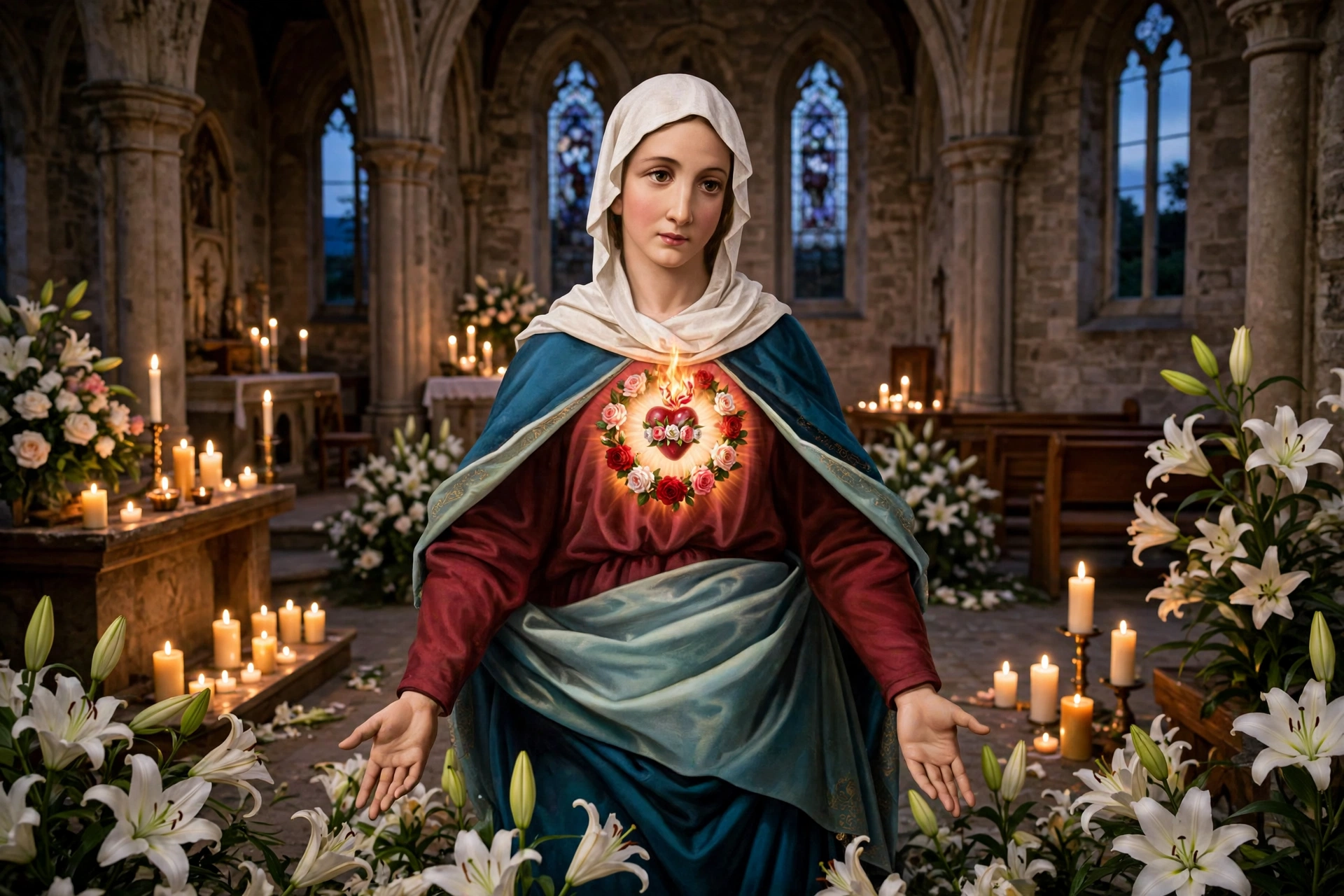
A devotion developed by Father Michał Mycielski, TJ, based on Jesuit spirituality and the devotion to the Sacred Heart of Mary. The novena consists of a daily introductory prayer, nine theological-spiritual reflections (reasons for trust) for each day, and a Litany and ejaculatory prayers.
O my Mother! I do not want and cannot fear that you would reject me when I turn to you and implore your support. If I were to fear such a thing, I would be insulting your mercy, which even seeks out the unfortunate to support them. O my most merciful Lady, do not deny mercy to anyone to whom the Lord Jesus did not deny His Blood. But the merits of this Most Precious Blood will not benefit me if you do not commend me to God. Is it so small a thing that you would not deign to hear me? No, I have no doubt about it. I hope that you have already heard me this moment; you are already praying for me, you are already obtaining for me the graces I implore, you have already taken me under your protection.
The same is true of our spiritual Mother, Mary. She has a Son in Heaven, the King of kings, the Lord of lords, Jesus Christ, Man and God Almighty, who loves His Mother so wonderfully, and she also has many sons on earth, poor beggars. For all of us, as Saint Augustine says, living here in this valley of tears, "are beggars to God," who stand before His door and daily reach out to Him.
The third reason for the Heart of the Virgin Mary to love us is the clear message she has and had: that we are purchased at the price of the death of Jesus Christ, who died on the Cross for the salvation of sinners. And this is a reason to love us with all her heart. For if the Blessed Virgin Mary loved us only a little, she would not value the Blood of her Son, which was the price of our ransom from sin.
This is the teaching of the Doctors of the Church, Saint Thomas Aquinas and Saint Alphonsus Liguore (St. Mary's Letter I, 1, § 1), that the Lord Jesus, in a sense, divided His Kingdom between Himself and His Mother: He left Himself the Kingdom of Justice, and entrusted to His Mother the Kingdom of Mercy. The throne on which this mercy rests, according to Father Gallifet (in his Memorial to the Holy Father), is the Heart of the Virgin Mary. But it is a throne exceedingly accessible, to which, although it is in heavenly heights, every mortal on earth can approach with trust through prayer.
"Virgin," says Saint Bernard (Serm. Virgin. M.), "Your Most Compassionate Heart is open to all; for in it the slave finds freedom, the prisoner liberation, the sick finds health, the sorrowful finds consolation, and the sinner finds forgiveness." And from this throne the reign of the Virgin Mary's mercy reaches the whole world. St. Bernard marks His boundaries in all directions thus (Serm. 4, de Assum.): "Who can measure His length, breadth, height, and depth? For His length is such that until the day of the final judgment, He comes to the aid of all who call upon this mercy. His breadth is such that it fills the earth, that the earth is full of Your mercy, O Lord, who is Mary (Ps 118:64). His height is such that through Him the high city of Jerusalem was renewed. And His depth is so great that it brought redemption to those dwelling in darkness and the shadow of death (Ps 107:10). For through Him, the unfilled Heaven, the emptied Hell, through Him, the heavenly Jerusalem arose from the ruins. To this fullness of mercy, therefore, let our misery cling with all its strength."
The image of this mercy's reign on earth, from His heavenly throne, is a rain cloud in the sky, a time of drought on earth, according to the words of Sirach (Sirach 35:26): beautiful mercy... in times of trouble, like a rain cloud in times of drought. Raymond Giordani writes in response to these words: "You, O Mary, with Your mercy, like a cloud, shield the sinner from the heat of the sun, that is, from the wrath of Your Son. You are their shade and refreshment, soothing the heat of His passions. You, like rain falling from heaven, fertilize hearts with the heavenly dew of grace, that they may produce virtuous deeds." Let us conclude, then, with the words of the Apostle: Let us therefore approach with confidence the Seat of grace, that we may receive mercy and find grace for serene salvation (Heb 4:16). For this Seat of grace, the merciful Heart of the Virgin Mary, as Abbot Guericus (Stim. am.) says, "is never inactive, but according to the greatness of His kindness, performs works of mercy at every moment," and as St. Bernard says (Serm. 1. in Dom. Eph.): "From the sources of mercy it is impossible for anything else to spring but mercy itself."
St. Gregory writes to Duchess Matilda (Lib. I, Ep. 47): "If you have the will to sin no more, be convinced that you will find the Most Holy Mary more ready to love you than your bodily mother." "This good Mother," writes St. Liguori (in the Glory of Mary), imposes no other conditions on the sinner than these two: that he commend himself to her and that he sincerely resolve to amend." When the Blessed Virgin Mary sees a sinner at her feet, begging her for mercy, she ignores his sins completely, but only asks for his intention. If his intention is good, she accepts him with all graciousness, even if he were the greatest sinner. And she zealously strives, as the best of mothers, to heal all the wounds of his soul.
When the Canaanite woman asked the Lord Jesus to free her daughter from the devil who had possessed her, she cried out to him: "Have mercy on me, O Lord, Son of David; my daughter is grievously tormented by the devil" (Mt 15:22). It would seem that this woman was wrong in saying, "Have mercy on me," and that she should have said, "Have mercy on my daughter," for it was not the mother who was possessed, but the daughter. But if we consider it carefully, we will recognize that she was right in saying, "Have mercy on me," for mothers take their daughters' sufferings to heart as if they themselves suffered them. "Similarly," says Richardus (de laud. Virg. c. 6), "it happens when a sinner prays to God for his soul in these words: Have mercy on me! And cries out: 'Look, Lord, this poor soul ensnared in the snares of sin, that is, the soul of my daughter—have mercy on me, if not on her, then on me, for I am her Mother.'" Oh, if only all sinners had recourse to this sweet Mother, surely God would have forgiven them all their sins.
This ark of the Old Testament covenant was highly esteemed by the chosen people because it held the tablets of God's Law. Saint Bonaventure (Exp. in 2 Luke) maintains that it was only a figure and image of the Ark of the Covenant, in which the mysteries of Christ's word were to be preserved, a figure of the Heart of the Virgin Mary. The Gospel itself mentions twice that Mary preserved the word of God in it, and Reverend Bede, explaining this (in hom. hiem. D. I. p. Ep.), explains that it was not only those words specifically mentioned in the Holy Gospel, but "everything that was said about the Lord Jesus or through the Lord Jesus, and moreover, His Most Holy Mother knew His deeds and treasured them all with the greatest care in Her Heart."
This Heart was also that good and excellent soil, most suitable for the seed of God's word, of which Christ the Lord speaks in the parable of the seed (Luke 8:15), that it bore fruit in patience. What fruit is this? The fruit and words of the Saints, some of which are recorded only in the Holy Gospel. "From this Heart," says Saint Bernardine (Serm. 9. de Visit.), "as from the hearth of love, the Blessed Virgin issued words of most ardent love."
Let us listen to at least one, spoken to the Lord Jesus at Cana in Galilee, asking for wine for the wedding guests: "They have no wine" (Jn 2:3). And let us consider that it was answered by the Lord Jesus through a strange miracle of His grace: the changing of water into wine, even though His time, the time for miracles, had not arrived and therefore had to be hastened for His Mother's request. "If Mary," says Saint Liguori (Glor. Mark I, 4, § 1), was so ready to help those poor people before they called on her help, how much more willing will she be to comfort the one who has recourse to her." And he adds: "If the Blessed Virgin Mary is so full of love for all, even for those who love her little and rarely turn to her, how much greater will be her love for those who love her and often invoke her help!"
The prophetic words of Simeon the Elder were fulfilled early: early on, a sword began to pierce the purest Heart of Mary, and on Mount Calvary, it penetrated and pierced it completely... It was a double-edged sword, inflicting wounds on two sides, and these wounds were: a wound of sorrow and a wound of love. They opened wide the Heart of the Immaculate Virgin for us, so that access to it would be easy and open to everyone, just as Longinus's spear opened the Heart of the Lord Jesus for us on the Cross. The wound of sorrow wounded this Heart early, as the Blessed Virgin Mary revealed to Saint Elizabeth, and as Rupertus Abbot beautifully expresses it, as it were, in the words of Mary herself (in Cant. cap. 1): "I foresaw the things to come, and therefore, from the moment I became a Mother, I knew what my Son would suffer. Therefore, as I held Him in my bosom and nursed Him at my breast, the details of His death appeared before my eyes."
Mary's Heart was torn most deeply and broadly as, standing beneath the Cross, she gazed upon all the sufferings of her Son, the insults and outrages hurled at Him, and heard His words of oppression. Saint Bonaventure and Saint Liguori speak of Mary's sorrow (on the Feast of Our Lady of Sorrows, 9): "Never has sorrow been so great, for never has a child been more loved by a mother, and this is because there was no child in the world more worthy of love than the Lord Jesus, nor a mother more loving than Mary." Saint Bernard, meanwhile, says (Serm. in Ap. 12): "A sword of sorrow will pierce your soul, so that we will call you the martyr of martyrs, because the sorrow of your Heart is greater than the bodily sorrows of martyrs." And now I ask, for whom did Mary suffer so under the Cross? Truly for us and for our salvation.
We, says Father Niremberg T.J., have thereby become children of Mary's sorrows, and Saint Alphonsus Liguori adds: "To mothers, the children of their sorrows are especially dear." Let this wound of sorrow in Mary's Heart encourage us to take refuge in Him. Since Mary suffered here for Christ, she can boldly show Him this wound in her Heart in Heaven today, all the more surely obtaining His grace for us.
But this loving Heart is also wounded by a wound of love. I would say that this wide wound in Her Heart is a wound of both sorrow and love. For love wounds the loving Heart with sorrow, and sorrow wounds it, igniting a new, more vibrant, and more fervent love. Let us listen to the words of St. Bernard (Serm. 29, in Cant.) about this wound of love: "The chosen arrow is also the love of Christ, which not only wounded but also pierced the Heart of Mary, so that not a single corner of Mary's virginal breast was left free from love. She loved with her whole heart, with her whole soul, with all her strength, for she was full of grace. And truly, such was the fullness of grace that we also received from this fullness, that we too draw from her, that Mary became to us as loving a Mother as God is to us as loving a Father."
Just as the Son of God did not want to take flesh from her and begin life in human nature without Mary's consent, so also did he not want to end the life she had given him and offer it as a sacrifice for humanity without her consent. Loving humanity with the Lord Jesus, the Sorrowful Mother, as it were, with a heart shared with Him, gave this consent. Hence, expressing in our own words the thought of Arnold of Carthusia (de Laud. Mar.) and Saint Liguore, we can say that in that ancient Tabernacle of the Jerusalem Church there were two altars: one, the altar of the Cross of Christ, on which He offered His life for the salvation of mankind; the other, the altar of the Heart of Mary, on which She also offered Her own life for the salvation of the world and that which was far dearer to Her than Her own life, that is, the life of Her Most Precious Son, the Lord Jesus.
Let us exclaim here with Saint Bonaventure: Mary so loved the world that she gave her only Son (Jn 3:16) to suffer for us. Let us exclaim with Saint Bernardine of Senna (I. Serm. 51, c. 4): "O wondrous mercy for us of the Father and Mother of Jesus! O inestimable power of the love for us of the Lord God and the Most Pure Virgin! To save their servant, they delivered their common Son to the sufferings of the Cross." So let us exclaim with confidence: If the Heart of Mary had to become the altar of the most difficult sacrifice to help us, and out of love for us did not shrink from this sacrifice, then today, when our help requires only intercession for us with the Son of God, it will surely never disappoint our hope!
Father Pinamonti T.J. says: "Just as the Lord Jesus was most like His Mother in body, so the Most Holy Mary was most like Her Son in soul, and Her Heart was the most faithful image of the Heart of the Lord Jesus." No wonder, indeed, because this Immaculate, Most Sacred Heart, from the very moment it began to beat, was adorned by God with all the abundance of grace to become a Heart worthy of the Mother of the Son of God. And it was fitting that, just as the first Christians, the multitude of believers, were of one heart and one soul (Acts 4:32), so, in an even more perfect degree, the Heart of the Mother of God and the Divine Son were one. This Son, too, says Saint Ambrose, "desiring to redeem the world, began His work from His Mother." And besides, this Heart beat for so long and so close to the Heart of the Lord Jesus! He dwelt beneath this Heart for so long... Could this have remained without a great effect on the Mother's Heart?
We can also say this in advance, even if we had no other knowledge of the Heart of the Virgin Mary and its virtues and attributes, that Her Heart was most similar to the Heart of Jesus. But what we know about the life and feelings of the Blessed Virgin Mary also fully confirms this truth. Hence, Father Gallifet writes beautifully in the Memorial presented to the Holy See: "Only turn your eyes first to the Lord Jesus, and you will see that He is the most humble, gentlest, most patient, most obedient, most pure, most innocent, most merciful, most full of love, and the Most Holy. And again, look at Mary, and you will immediately notice that she again surpasses and far surpasses all other people (except the Lord Jesus) in humility, gentleness, patience, obedience, purity, innocence, mercy, love, and holiness." And if these two Hearts of Jesus and the Virgin Mary are so similar, so united and clinging to each other, will not their power, mercy, and goodness toward us also be similar? Should not our hearts also be filled with the same desire to turn to the Hearts of the Mother and the Son in our times of need?”
Saint Liguori (Bol. 6) echoes Hubert Cazala’s tender words: “If you, children, wish to find a place in the Heart of Jesus, go to Mary so that she may obtain this grace for you.” And Father Gallifet, in his memorial on the veneration of Jesus and Mary, writes: “Through the Heart of the Lord Jesus, we will obtain everything from the Eternal Father; and likewise, we will obtain everything from the Lord Jesus through the Heart of Mary.” But why is it beneficial and good for us to choose the path to the Heart of the Lord Jesus, through the Heart of Mary, when the Heart of the Lord Jesus itself already stands open to everyone and the voice of that Heart calls to us: Come to me, all you who labor and are heavy laden, and I will give you rest (Mt 11:28). Why? At least I will briefly give two reasons.
First, because this way is safer and more certain. For prayers are often answered more quickly through the Heart of Mary than through the Heart of Jesus. The same can be said about this as Eumerus, a disciple of St. Anselm (Lib. de Ex. V. 6), says about the quicker hearing of prayers through the invocation of Mary's name. "It is not from this that Mary possesses greater power and authority than her Son; far from it. However, whatever power and authority she possesses, she possesses all this only by the will and grace of her Son. Why, then, is prayer often answered more quickly at the invocation of her name than at the invocation of her Son's? I will tell you what I think. Her Son is the Lord of all creation and the Judge who distinguishes the merits of each person; therefore, when it happens that he does not grant the petition of those who turn to him, he acts justly. But if someone turns to the Heart of Mary, even though he himself has not deserved to be heard, he is nevertheless answered because the merits of the Mother speak for him." The second reason is that for Mary's loving children, every gift of God, because it passes through the hands of the best of Mothers and is offered to us by Her hand, becomes even more pleasing to our Hearts and inspires us to a greater love for the Blessed Virgin Mary when, in the gift received, we recognize both the Heart of our Savior, the love, and the Heart of the Mother of God, the love." "The graces," says St. Bernardine (Serm. de B. Virg.), "that we receive through Mary's hands are somehow more pleasing. And if God were to give me the choice of drawing His gifts from the very source or receiving them through the hands of Mary, the Mediatrix of God's graces, I confess that, bending my knees, I would most earnestly pray to God that all His gifts might flow to me through this Mediatrix of God's graces; that I might proceed through Her to God, as God Himself descended to earth through Her." Now we recite the Litany of the Most Pure Heart of the Blessed Virgin Mary (For private devotion)
O Most Affectionate Heart of Mary, who is the purest of all creatures, most burning with love for the Heart of Jesus, and most merciful towards us sinners, obtain for us from the Heart of the Lord Jesus, our Savior, all the graces we ask of You. O Mother of Mercy! One sigh of Yours, one movement of Your Heart, burning with love for the Heart of the Lord Jesus, Your Divine Son, can completely comfort us. Grant us this grace, and this Divine Heart of Jesus, for the sake of the filial love it has had and always will have for You, will undoubtedly hear You. Amen.
Heart of Mary, Daughter of the Heavenly Father – lead us to the Father. Heart of Mary, Mother of the Son of God – reconcile us with the Son. Heart of Mary, Spouse of the Holy Spirit – fill us with the Holy Spirit. Heart of Mary, Immaculate Virgin – grant us purity. Heart of Mary, our Teacher – instruct us. Heart of Mary, our Guide – lead us. Heart of Mary, our Queen – command us. Heart of Mary, our Physician – heal us. Heart of Mary, our Comforter – console us. Heart of Mary, our Hope – save us.
Heart of Mary, our Refuge – deliver us from evil. Heart of Mary, our Mother – we surrender ourselves to you with all our hearts. Heart of Mary, with God's love, ignite us – that we may love you in Heaven.
 Top