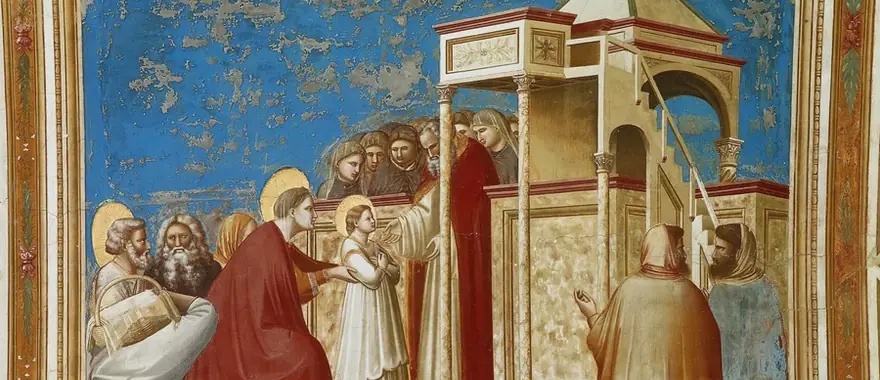
The Joyful Mysteries are a contemplation of God's humiliation. In "Sermon 187," Saint Augustine summarizes this mystery with the words: "Man became God because God became man." Saint Bernard of Clairvaux invites us to admire "the immeasurable height that becomes so small." Saint Thomas Aquinas, in his "Summa Theologica," explains that the Incarnation was necessary to restore human nature, not out of compulsion, but out of "the propriety of mercy." In his "Christmas Meditations," Saint Alphonsus Liguori reminds us that God became a child so that we might cease to fear Him and begin to love Him.
Hail Mary... Glory be to the Father... O my Jesus...
The presence of God generates active love. Saint Alphonsus Liguori, in his "Glorifications of Mary," calls Mary "the Dispenser of all graces," pointing out that the first grace she brought was the sanctification of John the Baptist. Saint Ambrose (Augustine's master) wrote that Mary went "with haste" because "the grace of the Holy Spirit does not tolerate slow delays." Saint Bernard notes that Mary's voice became a sacrament for John, awakening him to life in Elizabeth's womb. Here we learn that carrying God within oneself (the state of sanctifying grace) must bear fruit in service to one's neighbor.
God comes first. The twelve-year-old Jesus reveals his divine identity. Saint Bede (often quoted in Saint Thomas's Catena Aurea) observes: "He did not disregard his parents, but preferred the Heavenly Father to earthly bonds." Saint Augustine comments on this event as a lesson for us: "If we have lost God, we must seek Him with sorrowful hearts, in His temple." Saint Alphonsus Liguori, in his meditations on the Sorrows of Mary, writes that this sorrow was the greatest because Mary feared that she had lost Jesus through her own fault. Finding Him teaching teaches us that God's Wisdom transcends human understanding.
 Top