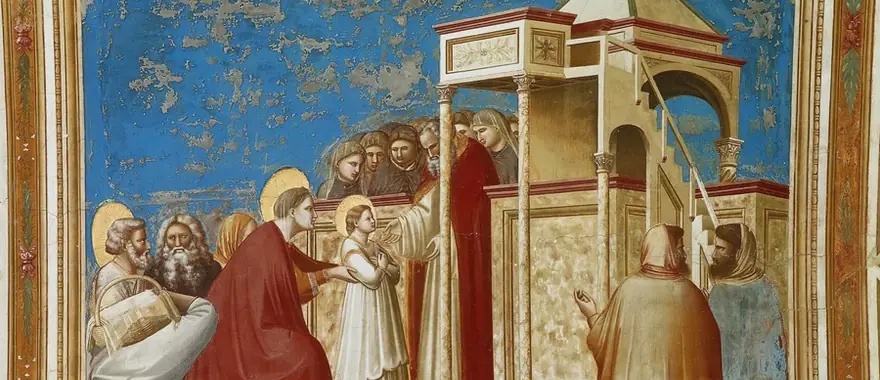
The history of sin began in the Garden of Eden with the words "I will not serve." The history of salvation culminates in the Garden of Olives with the words "Thy will be done." Entering the darkness of Gethsemane, Jesus takes upon himself the existential loneliness of every person rejected by sin. This is not simply the fear of death, but the theological terror of the "cup"—the biblical symbol of judgment on iniquity. The bloody sweat is a sign that within His body, a battle for faithfulness to the Covenant is waged, one that we so often lose.
Our Father...
We recite the Hail Mary 10 times.
Hail Mary... Glory be to the Father... O my Jesus...
The body of Christ becomes a written scroll on which Roman scourges tear out the history of human sins. The prophet Isaiah saw Him as "the Man of Sorrows," so disfigured that He no longer resembled a human being. In this mystery, God allows the form of Beauty to be destroyed in order to reveal the beauty of Love, which endures all things. The self-denial at the pillar is a response to human vanity and the cult of the flesh. Jesus allows himself to be reduced to pain in order to sanctify every human physical suffering.
In the Book of Genesis, the result of original sin is the earth bearing "thorns and thistles." By taking the crown of thorns, Christ symbolically takes upon his own head the entire curse weighing upon the world. This is a tragic parody of kingship, which paradoxically reveals the truth: His kingdom is not of this world, based not on violence but on sacrifice. The mocked King becomes the judge of human pride, and His silence is louder than the cry of the crowd demanding power and games.
Just as Isaac carried wood to Mount Moriah for his own burnt offering, so Jesus carries the cross to Golgotha. This fulfills the figure of the "Scapegoat," who is led outside the camp to die for the sins of the people. The Way of the Cross is a procession of the New Covenant. Christ does not escape the burden, but transforms it – what was once an instrument of shame, in His hands, becomes the key to the Gate of Heaven. Every one of our falls has already been foreseen here and lifted by the Savior.
When Adam fell asleep, God created Eve from his side. When the New Adam – Jesus – falls asleep in the sleep of death on the Cross, the Church, symbolized by Blood (Eucharist) and Water (Baptism), is born from His pierced side. The Cross becomes the Altar of the world. The rending of the veil in the Temple of Jerusalem signifies the end of ancient sacrifices and the opening of direct access to God for every person. Death is not the end, but the "fulfillment" of the work of redemption – the seal of infinite Mercy.
 Top